
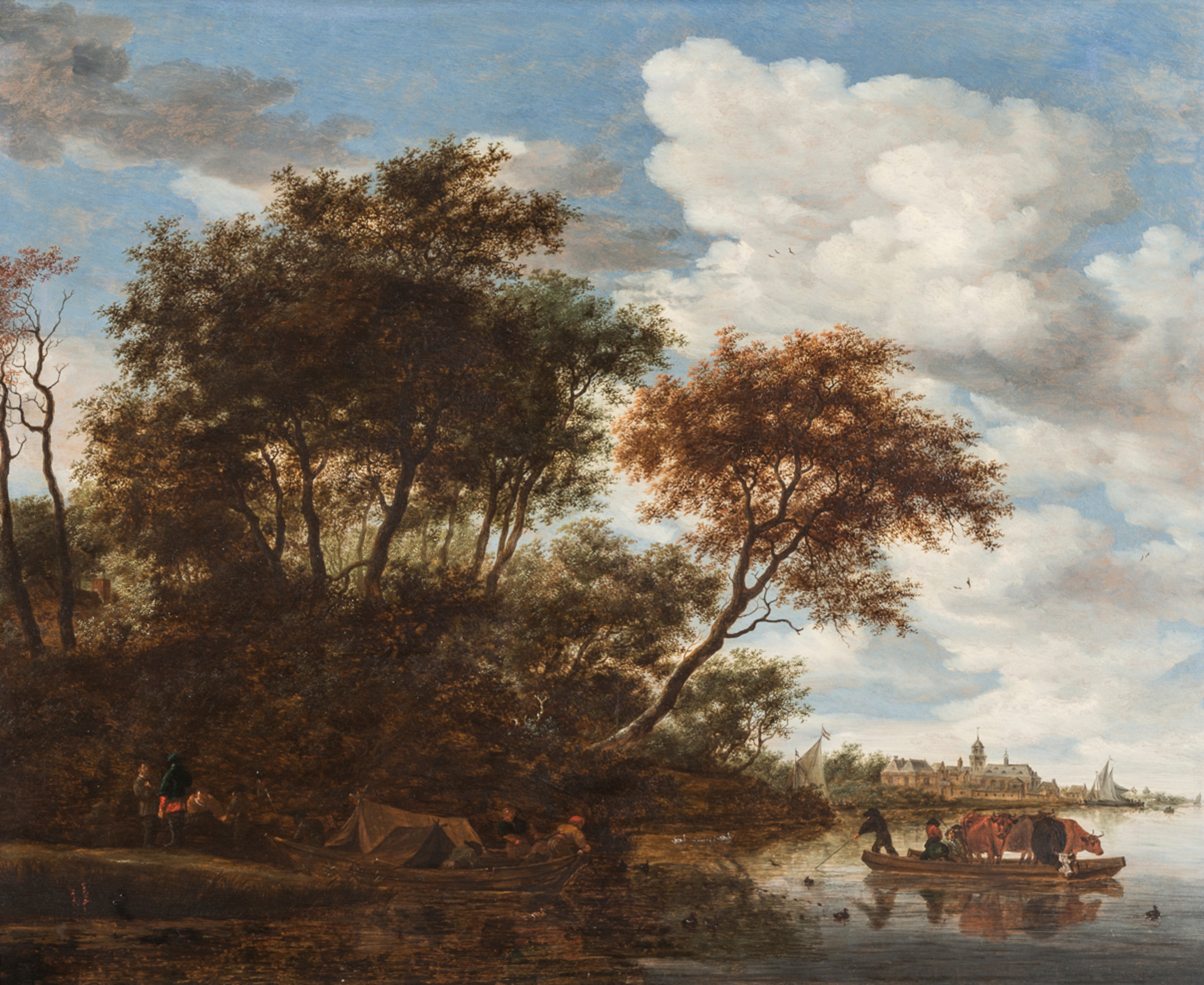
Een schilderij van Salomon van Ruysdael in de veiling van London, 7 december 2022 met Nijenrode erop
Aanstaande woensdag 7 December is er de unieke kans om een Oude Meester, die zelfs ín Kasteel Nijenrode gehangen heeft, te bemachtigen.
Zie hieronder meer informatie en een linkje naar een mooi schilderij van Salomon van Ruysdael in de veiling van Sotheby's London, 7 december 2022 met Nijenrode erop.
Old Masters Evening Sale, London, 7 December 2022
SALOMON VAN RUYSDAEL
A VIEW ON THE RIVER VECHT WITH KASTEEL NIJENRODE BEYOND
oil on oak panel, 72 x 88.5 cm
£200,000-300,000
An Old Master painting by Ruysdael that was stolen in one of the largest single plunders by the Nazis has been restituted to the heirs of its original owner - the famed collector and dealer Jacques Goudstikker - more than 80 years later.
The history of Goudstikker’s collection, and of his family’s efforts to see it returned to them after the war, is one of the most storied of the era, and the recovery of this painting - a historic view of Goudstikker’s country retreat (and the setting for society events) called Kasteel Nijenrodem near Amsterdam - marks another step in the ongoing search to discover the numerous works that still remain unaccounted for.
This painting is one of approximately 800 works from Goudstikker’s holdings that was taken by Hermann Göring in Amsterdam in 1940 after the collector fled the Netherlands for the UK in 1939. It was subsequently despatched to Carinhall, Göring’s country home (a large hunting estate north-east of Berlin).
As the Red Army began to advance on the house (and Göring instructed the Luftwaffe to destroy Cairnhall), the painting was transferred for safekeeping to the hills around Berchtesgaden (near the Austrian border).
While Goudstikker himself had begun helping Jewish refugees arriving in The Netherlands, believing it to be a safe haven, he too was eventually forced to leave as the Nazi’s advanced, finding passage on a boat on 13 May 1940, the day before the country was invaded. He would never see land again, dying aboard the boat to the UK (he is buried in Falmouth), however the black book he carried with him on the journey documenting the treasures held in his collection and gallery, would prove instrumental in helping his family see the return of over 200 works to them in the years that have followed.
While this painting has appeared at public auction several times over the past seventy years, it is thanks to the complete transformation of access to records of missing artworks in the years since its last auction in 1985, that the true history of this painting was unveiled. During an inspection of the work, Sotheby’s co-Chairman of Old Master Paintings, George Gordon, spotted several historic labels on the reverse with the Goudstikker name, and set in motion for the work to be checked against the corresponding art lot databases and restituted to his heir.
More about the painting:
Kasteel Nijenrode - perhaps due to its accessibility from Amsterdam via the river - and certainly due to its architecture and prominent riverside position next to the River Vecht, was often drawn, painted and engraved in the second half of the 17th century and after.
Ruysdael himself painted views of the castle on at least four occasions, all depicting the castle from an imaginary viewpoint mid-stream in the river Vecht, with Nijenrode on the left bank. The earliest of these - a work dated 1649 - also once belonged to Jacques Goudstikker, was looted during the war and later restituted to his heir in 2006. The Castle itself was seized by the Nazi’s at the same time as the collection.
Nijenrode and the present painting both previously belonged to the coffee merchant Michiel Onnes (1878–1972), who styled himself Onnes van Nijenrode upon acquiring the castle after his return from Brazil. Jacques Goudstikker acquired the house from Onnes in 1930 and used it as a country retreat, filling it with art treasures and opening it to the public in 1935. He later acquired the painting at Onnes van Nijenrode's sale in 1933 for 4,600 Guilders, no doubt in the light of his acquisition of the castle three years before, but surely also aware that Ruysdael was an under-appreciated artist whose time had come – this painting was included in the first ever exhibition devoted to Ruysdael mounted by Jacques Goudstikker in his Amsterdam gallery in 1936.